As the pharmaceutical industry expands to meet growing global demand for biologics, vaccines, and advanced therapies, companies are constantly planning new facilities and capacity expansions. However, planning a production expansion is rarely straightforward.
Engineering teams must make critical decisions early in the project lifecycle – often with limited data and tight timelines. Assumptions about production throughput, equipment utilisation, scheduling constraints, and storage capacity frequently drive investment decisions worth millions.
The challenge is that traditional engineering calculations and spreadsheet-based planning methods struggle to capture the complexity of modern pharmaceutical production systems. Interdependencies between process equipment, utilities, shift patterns, cleaning cycles, and material flows create dynamic behaviours that are difficult to predict accurately.
This often leads to common gaps in expansion planning:
- Overestimating capacity constraints and investing in unnecessary equipment
- Underestimating bottlenecks in buffer storage, utilities, or scheduling
- Limited ability to test “what-if” scenarios during early design stages
- Poor visibility into resource utilisation across the facility
- Late design changes that increase CAPEX and delay project timelines
Without a holistic view of the entire production system, companies risk either over-investing in infrastructure or discovering operational bottlenecks only after commissioning.
This is where simulation-driven engineering becomes a powerful decision-making tool.
Case Study
The Challenge: Validating Capacity for a New Facility
A pharmaceutical manufacturer planning a new facility for plasma-derived products faced a critical question.
Initial planning indicated that additional capacity would be required to meet future production targets. Based on these projections, the company was preparing to invest in an additional line.
However, before committing to the investment, the project team wanted to validate whether the planned facility configuration could actually meet production targets – and whether there were hidden inefficiencies or untapped capacity in the system.
The key questions included:
- Can the planned equipment configuration achieve the required annual production volumes?
- Are there hidden bottlenecks in production scheduling or material flow?
- How efficiently will the lines be utilised?
- Is additional equipment truly necessary?
To answer these questions with confidence, the company partnered with ZETA to perform a comprehensive simulation study of the proposed production system.
The Solution: Simulation-Driven Decision Making with INOSIM Insight
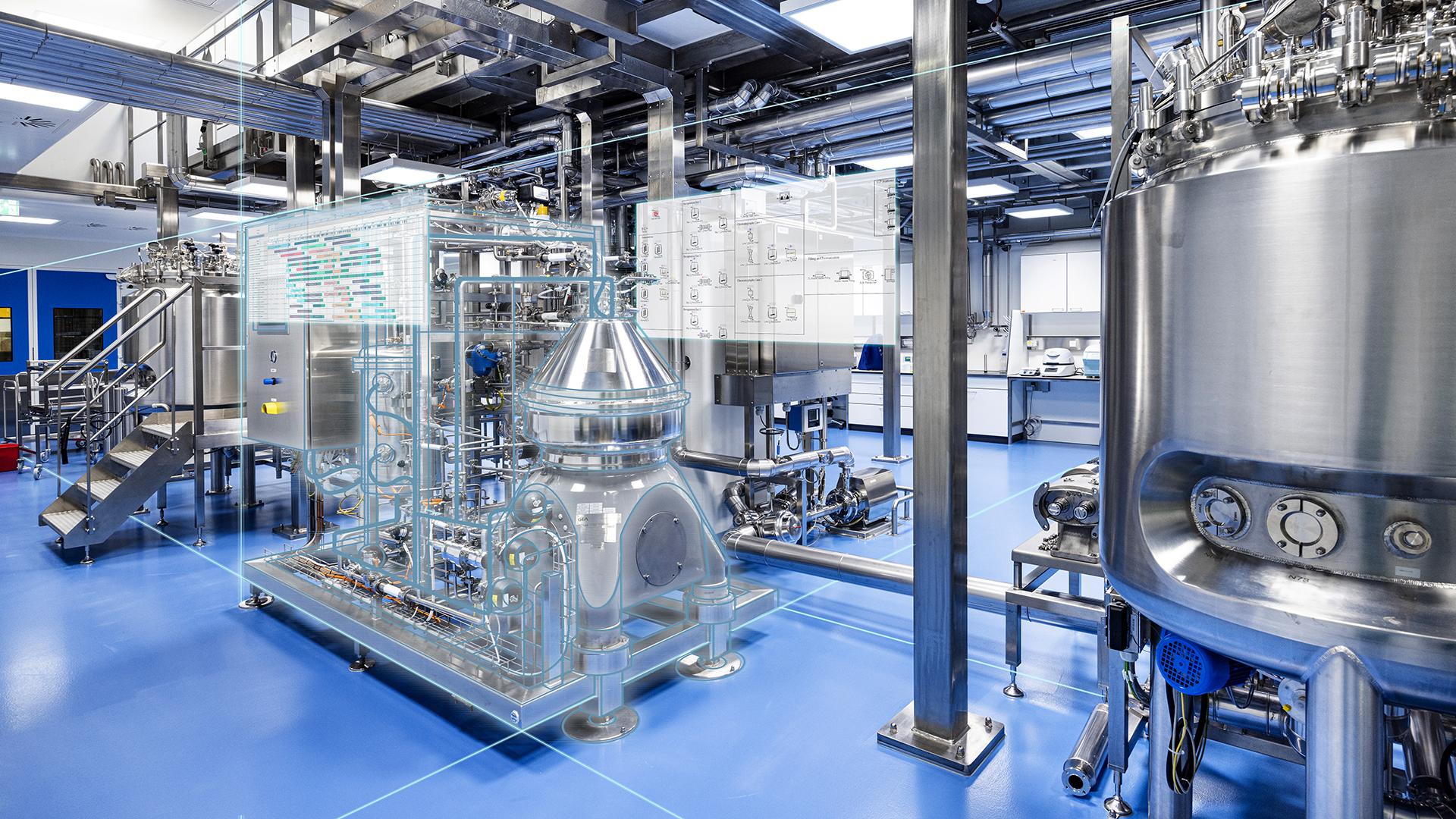
ZETA developed a detailed simulation model of the entire process using INOSIM Insight, an advanced process simulation platform designed for complex pharmaceutical production environments.
INOSIM Insight uses discrete event simulation to digitally recreate production workflows. This allows engineers to model the entire facility and analyse how equipment, materials, personnel, and utilities interact under real operating conditions.
The simulation model incorporated multiple real-world variables, including:
- Equipment performance and cycle times
- Production scheduling logic
- Material flow and buffer storage
- Shift patterns and staffing constraints
- Maintenance and downtime scenarios
Unlike traditional scheduling tools, INOSIM enables engineers to rapidly test multiple operational scenarios and evaluate the impact of design changes before construction begins.
This approach allowed ZETA to compare:
- The customer’s original facility design
- Optimised production scenarios developed through simulation
The entire simulation study was completed well within time, enabling the project team to make timely decisions while the facility design was still flexible.
Key Capabilities of INOSIM Insight
INOSIM Insight plays a critical role in enabling simulation-driven engineering across the pharmaceutical plant lifecycle.
Key capabilities include:
Holistic facility modelling
INOSIM models the entire production system – not just individual equipment. Production processes, utilities, material preparation, logistics, and scheduling dependencies can all be simulated in one integrated environment.
Scenario-based decision making
Engineering teams can virtually test different design and operational scenarios to evaluate capacity, identify bottlenecks, and optimise production strategies before implementation.
Faster time to market
Early simulation and “what-if” analysis help accelerate plant design and reduce project timelines by enabling faster engineering decisions.
CAPEX and OPEX optimization
Better planning and balanced equipment utilisation can reduce investment costs by more than 10% while improving operational efficiency.
Flexible and user-friendly modeling
Simulation models can be easily updated as the project evolves, allowing them to remain useful throughout the entire engineering lifecycle and even into operational optimisation.
The Outcome: Avoiding Millions in CAPEX Investment
The simulation results provided a clear and data-driven answer.
The analysis demonstrated that the existing equipment configuration could achieve the planned production targets with optimal scheduling and resource utilisation. The lines were projected to operate at approximately 83% utilisation, confirming that additional equipment was not required.
As a result, the company was able to avoid investing in an additional line, thereby saving a few millions in capital expenditure.
The simulation also enabled further operational improvements. An optimised production scheduling algorithm developed within the model created two additional free production weeks per year, providing greater flexibility and operational resilience.
When Simulation Delivers the Most Value
Simulation is particularly valuable in situations where production systems are complex and capital investments are significant. Typical scenarios include:
- Planning new biopharmaceutical manufacturing facilities
- Evaluating capacity expansion for existing plants
- Introducing new products or modalities into existing production lines
- Optimising operations and batch scheduling
- Assessing material flow, buffer storage, and logistics constraints
- Validating facility design decisions during early engineering stages
In these scenarios, simulation enables pharmaceutical companies to move from assumption-based planning to data-driven facility design, ensuring that expansion projects deliver the required capacity, efficiency, and return on investment.