
If you need higher titres without taking on the operational burden of a fully continuous plant, a feeding-led approach is often the most reliable route. It’s a solution-oriented way to keep a culture productive for longer, especially when the biology becomes highly complex at scale and the process needs a tailor-made control strategy. The key is simple: instead of loading everything at the start, you control what the organism sees as the run evolves.
What “Fed-Batch” Means
Fed-batch fermentation starts with an initial charge of fermentation medium in a fermenter or bioreactor, then adds one or more feeds during the run (typically without intentional broth removal, aside from sampling). In most industrial set-ups, the vessel is charged below its final working volume to allow for feed additions, and feeds are often concentrated to manage volume increase. The aim is to manage nutrient availability over time so growth and metabolism stay inside a defined operating window.
This mode sits between a simple batch and a steady-state operation:
- Batch fermentation: charge once, let the run progress, then harvest.
- Continuous fermentation: add fresh medium and remove culture at the same time to maintain a steady state (in cell-culture contexts, continuous operation may also include perfusion-style approaches with cell retention).
Fed-batch keeps the run boundaries of batch (clear start, run, and harvest) while adding the control lever of feeding.
Why Teams Choose This Mode
Many organisms do not behave well when the full nutrient load is present from the start. High initial carbon can trigger inhibition, stress responses, or overflow metabolism, which lowers quality and creates unwanted by-products. Feeding lets you keep the culture slightly limited in a controlled way, which often improves consistency, extends the productive window, and stabilises output across production processes.
How the Process Works (Step by Step)
Charge, inoculate, and establish baseline conditions
The run begins by charging the vessel and inoculating with a prepared seed so cell growth starts in a controlled start-up period. At this stage, you want stable fundamentals—mixing, temperature, and pH—before you introduce feeding as an additional variable.
Lock in monitoring and process control
Before feeding starts, you stabilise the core control loops and confirm the signals are trustworthy. That typically includes:
- temperature and pH (with additions as needed)
- agitation and aeration
- dissolved oxygen (DO) and alarms
Good process control is what makes feeding repeatable. If sensors drift or loops oscillate, feeding can amplify variability rather than reduce it.
Start feeding at the right time
Feed usually begins when the initial carbon source is close to depletion and the culture is metabolically active. Starting too late risks limitation and reduced output; starting too early risks over-feeding and by-product formation.
In practice, the “start feed” decision is guided by a combination of measurements and trends (for example, DO behaviour, off-gas data where available, or direct substrate testing).
Use feed rate to steer growth and production
This is the core idea: the feed rate becomes a steering wheel. By controlling the nutrient input, you can target a desired specific growth rate, manage metabolic stress, and time the run so product formation stays in the intended window.
Two common patterns are:
- Growth-limited operation where a controlled carbon input prevents substrate accumulation.
- High-density operation where feeding is used to build a high cell population while staying within oxygen and cooling limits.
As biomass builds, the process becomes more sensitive to equipment headroom. The feed profile is therefore often tuned around oxygen delivery and heat removal constraints rather than biology alone.
Endpoint and harvest
When the run reaches its endpoint (titre, quality window, or operational constraints), the entire vessel is harvested as fermentation broth and sent to downstream processing. Cleaning, sterilisation, and set-up then prepare the system for the next run.
Common Feeding Strategies (and When They Fit)
Feeding strategies are selected to match organism behaviour, utility limits, and the target product pathway.
- Constant-rate feeding: simple to implement; best when demand does not shift dramatically during the run.
- Step feeding: increases feed in stages as the culture expands; a practical option when you want more control without heavy modelling.
- Exponential feeding: ramps feed to match expected biomass increase; useful for building density in a controlled way.
- Feedback feeding (DO-stat / pH-stat): uses sensor trends to trigger feed when the culture becomes carbon-limited (process-dependent).
Some plants also apply repeated fed-batch, where part of the culture is retained and fresh medium is added between cycles. In some variants, a portion of broth is withdrawn (a “bleed”) and replaced with fresh medium to control volume or extend operation. These approaches can improve utilisation, but they raise the bar for hygiene discipline and trend monitoring.
What Makes Fed-Batch Technically Demanding
Oxygen, heat, and mixing limits at higher density
Feeding pushes metabolism, which increases oxygen uptake and heat generation. If oxygen-transfer or cooling capacity is marginal, the process must be fed conservatively, which can reduce the performance gain you expected from higher density.
Local gradients from concentrated feeds
Feeds are often concentrated for practical reasons (tank volume, storage, sterilisation). If feed addition is poorly positioned or mixing is insufficient, local high concentrations can create inhibition, osmotic stress, or pH excursions that never show up in the average readings.
Longer runs increase exposure time
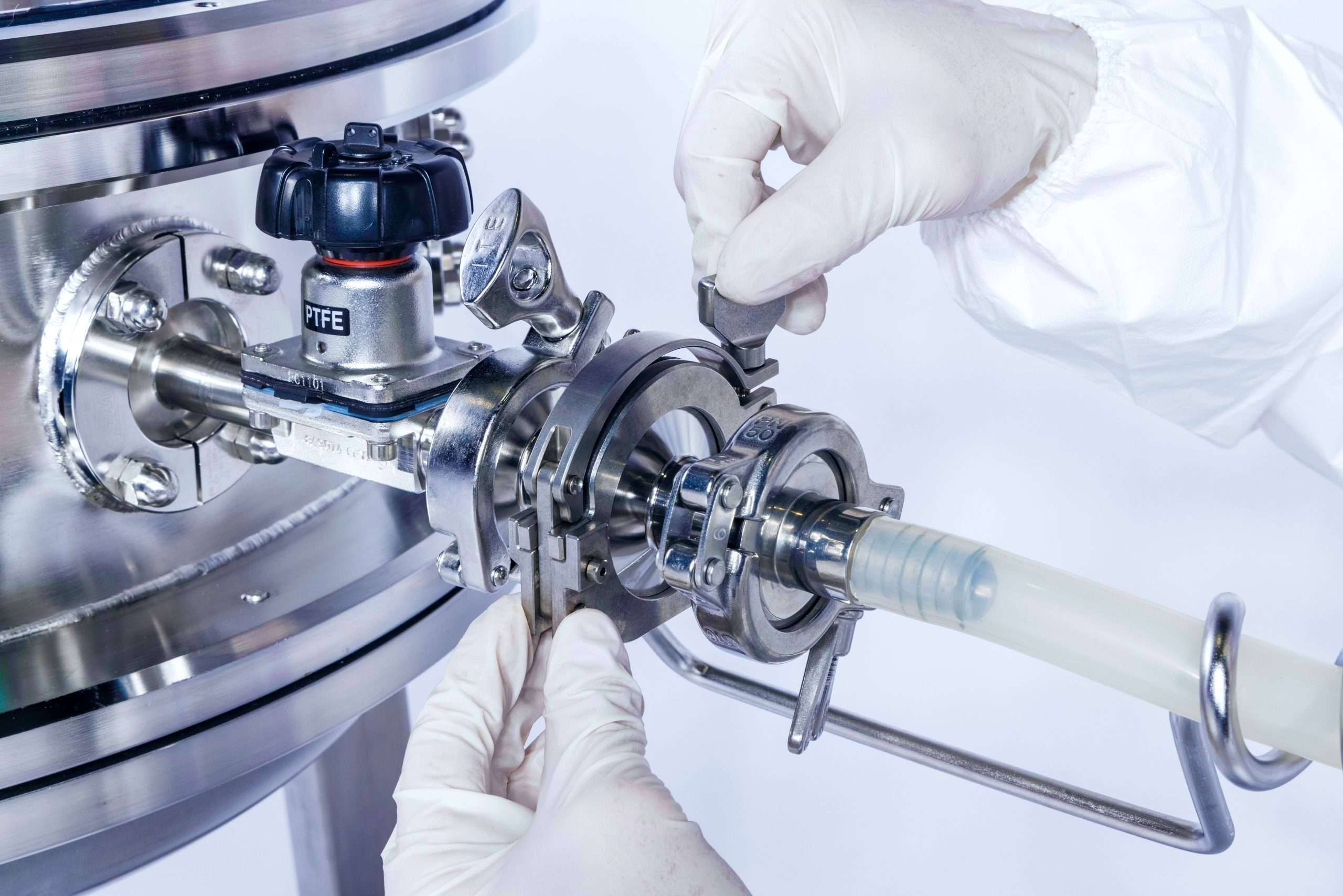
Because fed-batch runs are often longer than a simple batch, the risk of contamination rises. Closed additions, sterile filtration, aseptic connections, and disciplined procedures are not “nice to have”—they protect the run.
By-products and pathway sensitivity
Over-feeding can push overflow metabolism. One well-known example in some high-growth bacterial systems is acetic acid formation when carbon is not properly controlled (organism- and condition-dependent). The first response is usually feed strategy and oxygen availability before changing anything else.
Advantages for Customers
- Higher titres and productivity by extending the productive window through controlled feeding
- Better by-product control by avoiding nutrient overload and metabolic “spill-over”
- More stable operation through smoother oxygen and heat demand rather than sharp spikes
- Faster optimisation because the feed profile is an adjustable lever without redesigning the whole system
- Scalable performance when mixing, oxygen-transfer, and utilities are specified for peak demand
Where This Mode Is Used
Fed-batch is common across industrial biotechnology and biomanufacturing where high yield and repeatability matter.
- Recombinant protein production: feeding helps sustain expression while managing metabolic stress.
- Production of amino acids: controlled nutrient input improves selectivity and reduces by-products.
- Production of organic acids (process-dependent): feeding influences productivity and can reduce inhibitory accumulation.
- Yeast processes (selected use-cases): controlled carbon input supports stable biomass build and conversion.
Choosing Between Batch, Fed-Batch, and Continuous
A practical way to decide is to match the operating mode to your constraints:
- Use batch when simplicity and fast changeovers matter most.
- Use fed-batch when you need higher titres with manageable complexity and clear run boundaries.
- Use continuous when steady-state throughput is the priority and long-term sterility/control discipline is proven.
Conclusion
Fed-batch fermentation is a controlled feeding method that improves productivity by shaping growth and metabolism during the run. By keeping nutrient availability within a defined window, it reduces inhibition, limits by-products, and supports more consistent product formation than simple batch operation. The best results come from process-led specification: feed strategy, oxygen-transfer capacity, heat removal, and instrumentation must work together. When designed and operated correctly, it delivers reliable scale-up and higher titres without the full complexity of continuous processing.