
When you need high cell densities, gentle handling, and efficient product accumulation—without scaling up to a large-scale stirred tank—a hollow-fiber bioreactor can be the reliable, production-ready route. This bioreactor technology is widely used for perfusion-style cell-culture, where the goal is to keep a cell line productive for longer while maintaining stable conditions, low shear, and a controlled exchange of oxygen and nutrients. In short: a hollow-fiber bioreactor (often shortened to a hollow fiber bioreactor or HFBR system) is a solution-oriented option for highly complex bioprocessing workflows that benefit from high surface area, cell retention, and tailor-made oxygen transfer and mass-transfer behaviour.
What is a hollow-fiber bioreactor?
A hollow-fiber bioreactor is a cell-culture bioreactor that uses a cartridge packed with thousands of semipermeable hollow fibers (each one a tiny tubular capillary with a fibre lumen). Culture medium flows inside the hollow fibers (within the hollow fibres), while cells are housed outside of the hollow fibers in a separate cell compartment, separated by a semi-permeable membrane wall. Small molecules (nutrients, metabolites, and some dissolved gases) move across that membrane down a concentration gradient, while the cells themselves are retained.
This design creates a very large membrane surface area in a compact reactor volume, which is why HFBRs can support high cell densities with gentle hydrodynamics. It makes them a popular format for mammalian cell culture in vitro, especially where shear-sensitive cells, controlled perfusion, and high concentrations of secreted proteins are priorities (process-dependent)—for example, some antibody and vaccine-adjacent workflows.
A short note on history: hollow-fiber formats were first popularised in academic bioreactor development work in the 1970s (often referenced through Knazek-style designs). Today’s systems are more automated and typically single-use, but the core concept—membrane-separated exchange with cell retention—remains the same.
The two spaces you will hear about
Hollow-fiber systems typically describe two compartments (sometimes written as IC and EC, or IC side and EC side):
- Intracapillary space (ICS): the inside of the hollow fibres (the fibre lumen), where medium commonly flows in an axial direction from inlet to outlet ports.
- Extracapillary space (ECS): the space outside the fibres (within the cartridge housing), where cells are often retained as the main cell compartment and where product may accumulate.
Depending on the design and application, cells can be cultured in the ECS (common for cell retention and product accumulation) or in the ICS (less common, but used in some set-ups).
How a hollow-fiber bioreactor works
Hollow-fiber bioreactors are best understood as a controlled diffusion and perfusion system.
- Perfusion and circulation Culture medium is circulated through the cartridge (usually via the ICS) using tubing fitted with inlet and outlet ports. A pump drives a continuous or semi-continuous medium flow so fresh nutrient reaches the membrane surface and waste products are carried away. The rate of medium (flow rate) is chosen to deliver stable nutrient supply while keeping shear low at the cell location and avoiding pressure spikes that can impact viability.
- Membrane-based mass transfer The membrane wall acts as a selective barrier. Small molecules (glucose, amino acids, salts, and some dissolved gases) can move across, while larger components are retained depending on the membrane’s molecular weight cut-off (MWCO) and pore structure.
This is where the system becomes powerful: you can retain cells and, in some cases, retain product in the ECS, allowing it to build to high concentrations. At the same time, the diffusion-driven exchange can create local gradients if consumption outpaces transport—so monitoring and perfusion control are part of good HFBR operation.
- Cell retention and high-density culture Because cells are physically separated from the main circulation flow, they are protected from high shear and can maintain higher cell mass than many suspension systems. Cells are seeded into the selected compartment (most commonly the ECS), then supported through perfusion as they expand. Waste metabolites such as lactate can accumulate if exchange is not sufficient, so perfusion settings are usually tuned around both nutrient uptake and waste removal.
- Product accumulation and harvest Many processes harvest product from the ECS (where it can concentrate) or from the circulating medium, depending on where the product is located and whether the membrane retains it. In practical terms, teams may harvest supernatant from the cell compartment to reduce dilution and lower downstream volumes. The harvest strategy is a key design choice because it determines downstream load (filtration capacity, chromatography loading, and overall purification effort) and overall recovery.
Key parts of a hollow-fiber bioreactor system
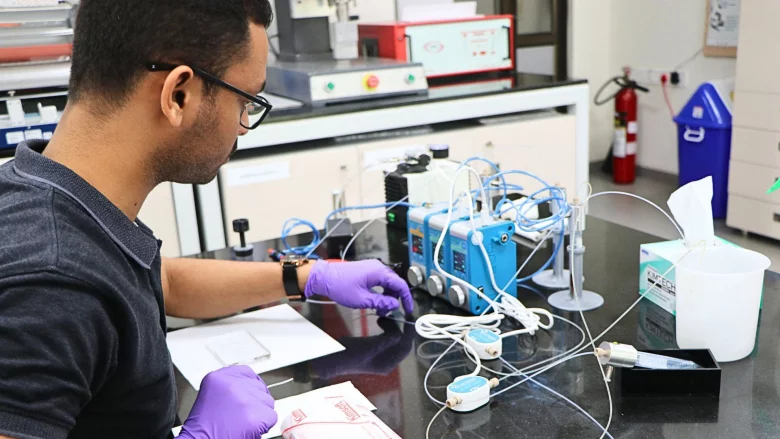
Although the cartridge is the “headline”, a working system includes several integrated components:
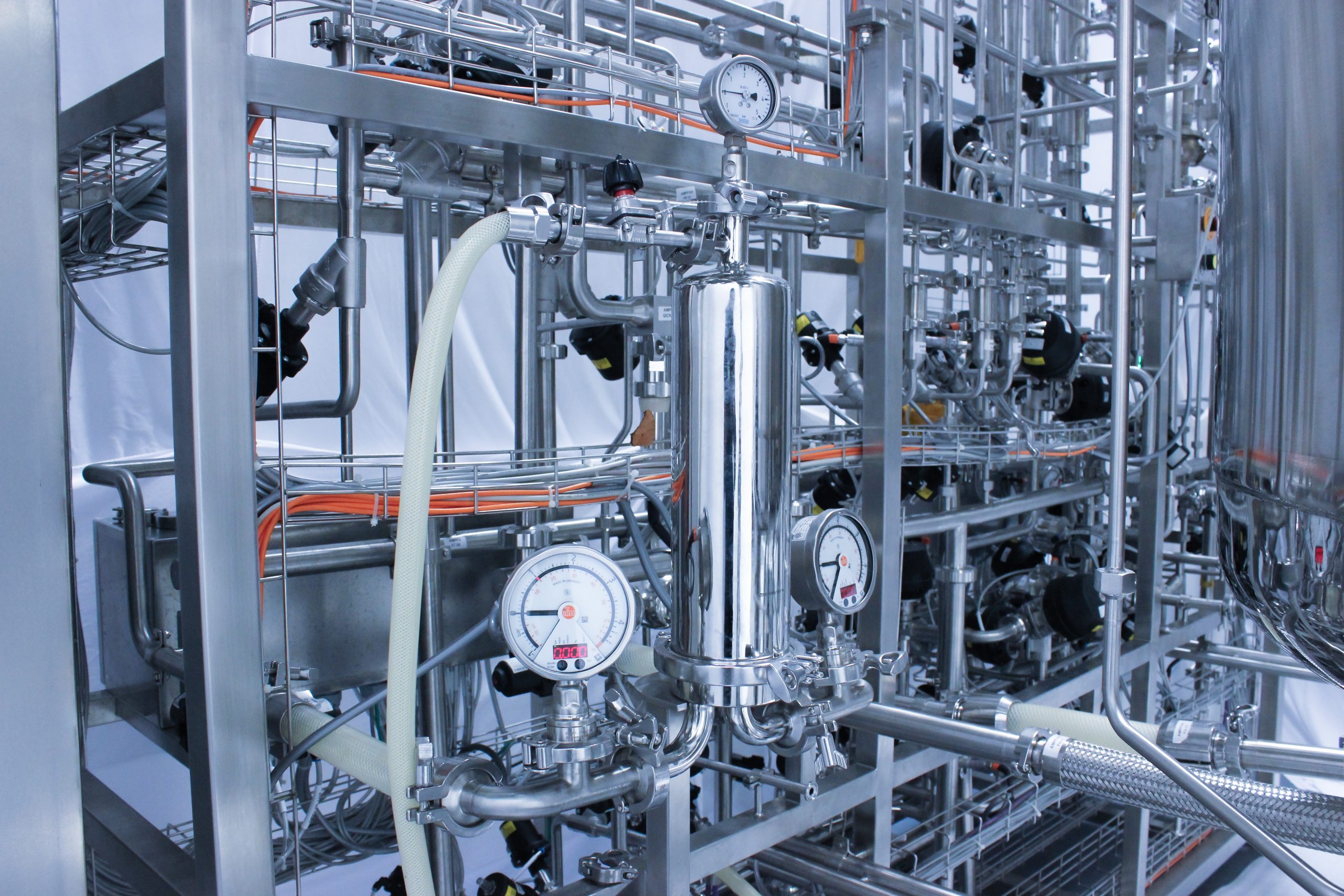
- Hollow-fiber cartridge: the cartridge contains a parallel array of hollow fibres (tubular capillaries) and is fitted with inlet and outlet ports; key choices include membrane material (e.g., polysulfone, cellulose derivatives, polypropylene; silicone in gas-exchange variants), fibre dimensions, surface area, and MWCO (molecular weight cut-off).
- Pump(s): control circulation rate through the ICS and, in some configurations, separate perfusion/bleed flows.
- Reservoir(s): for medium supply and, where used, harvest collection.
- Oxygenation and gas management: often via an external oxygenator (to oxygenate medium), gas-permeable tubing, or controlled headspace; because HFBRs do not rely on sparging, gas exchange and oxygen transfer are usually managed through medium conditioning and flow strategy.
- Sensors and monitoring: temperature, pH (often off-line or in-loop), dissolved oxygen (in-loop where configured), pressure, and flow.
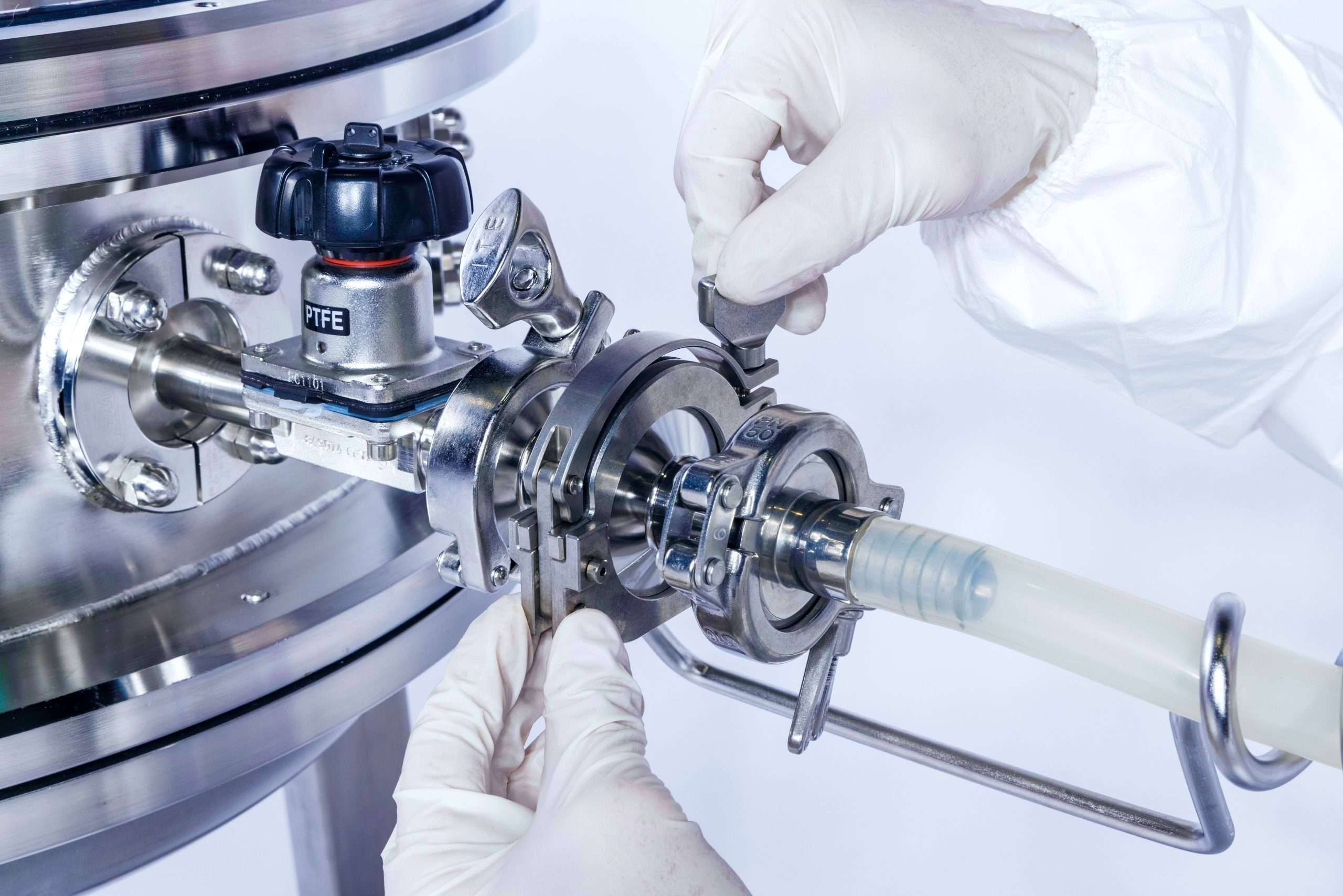
- Tubing, connectors, and sterile barriers: critical for contamination control—especially in long-duration perfusion runs; many modern systems are single-use, reducing cleaning burden and improving turn-around.
In many modern set-ups, the cartridge and fluid path are single-use, reducing cleaning burden and speeding turn-around.
Why teams choose hollow-fiber bioreactors
A hollow-fiber bioreactor is not a default replacement for stirred-tank systems. It is chosen because it offers a specific performance profile.
High surface area in a compact footprint
The membrane bundle provides a very large exchange surface relative to volume, supporting efficient nutrient/waste diffusion without requiring high agitation.
Low shear at the cell location
Cells are sheltered from impeller shear and sparging stress. This makes hollow-fiber attractive for shear-sensitive mammalian cells and some cell-based manufacturing steps.
Cell retention supports long, productive runs
Because cells are retained, you can maintain high biomass over time. This is naturally aligned with perfusion-style production, where you want consistent output over extended durations.
Potential product concentration
If the membrane retains the product (or the product is produced in the ECS), you can collect a more concentrated harvest. That can reduce downstream volumes and, in some cases, simplify capture.
Applications: where hollow-fiber bioreactors are used most
Hollow-fiber systems are most commonly used where high cell density, gentle conditions, and controlled exchange are valuable.
- Mammalian cell culture for secreted products: including certain recombinant proteins and monoclonal antibodies (process-dependent). High density—often using CHO cell lines in commercial settings—can support strong volumetric productivity in a compact footprint.
- Cell expansion: for research and process development, and in some controlled manufacturing contexts where consistent expansion and low shear are needed. Hollow-fiber formats can support both adherent and suspension-leaning cell types (process-dependent), including epithelial cells and some immune cell workflows where cytokine supplementation and controlled perfusion are important.
- Viral vector or vaccine-adjacent production: some workflows use hollow-fiber formats to support high cell densities for virus production or vector generation (process-dependent), with careful control of perfusion and harvest timing. Where virus or antigen is retained in a compartment, membrane choice and harvest location can materially change downstream load.
- Perfusion process development: as a platform to explore perfusion strategies, retention behaviour, and medium optimisation before committing to larger-scale systems.
The best fit is typically where cell retention is beneficial and where the process can tolerate (or benefit from) membrane-separated exchange.
Advantages for customers
When specified correctly, hollow-fiber bioreactors can deliver customer-facing benefits that are practical and measurable:
- Reliable high-density culture in a compact system, reducing the need for large vessel volumes.
- Gentle, low-shear operation that supports sensitive cells and more stable productivity.
- Tailor-made retention via MWCO selection—retain cells, and (in some cases) retain product for higher concentration.
- Efficient perfusion operation with stable nutrient supply and waste removal over long runs.
- Lower downstream volume when product accumulates at higher concentration, improving processing efficiency.
How to choose the right hollow-fiber bioreactor
Selecting a hollow-fiber system is about matching membrane and flow behaviour to biology and product goals.
Define the culture and output targets
Start with what “good” looks like: desired cell density, run duration, productivity, and whether the product is secreted, intracellular, or virus-associated (process-dependent). These choices set your retention and harvest strategy.
Choose membrane material and MWCO
MWCO is one of the most important parameters. It influences what passes across the membrane (nutrients, wastes, signalling molecules, product). A tighter membrane increases retention but may limit transport; a more open membrane improves exchange but may allow product loss into the circulation. Material compatibility also matters for adsorption, extractables/leachables (where relevant), and long-run stability.
Size surface area and working volumes
Cartridge surface area and ECS volume affect mass-transfer and product accumulation. Too little surface area can cause local nutrient limitation or waste build-up; too much can complicate control or increase cost without benefit.
Set a perfusion and flow strategy
Decide how you will deliver medium and remove waste: continuous perfusion, intermittent exchange, or staged approaches. The goal is stable conditions without excessive pressure drop. Flow settings should be conservative enough to avoid stressing cells via pressure transients while still delivering adequate exchange.
Plan oxygen strategy early
Hollow-fiber systems do not use the same aeration approach as stirred-tanks. Oxygen is often delivered via oxygenated medium (and sometimes an external oxygenator), and the real constraint can become oxygen supply and CO₂ removal at high density. If oxygen is likely to be limiting, plan monitoring and conditioning capacity early.
Decide how you will harvest
Will you harvest from the ECS, the circulation loop, or both? Product location and membrane retention define this. Harvest strategy directly influences downstream capture steps, filtration loads, and overall recovery.
Operational realities and common challenges
Hollow-fiber bioreactors can be highly effective, but they have practical constraints that should be designed in rather than discovered late.
- Mass-transfer limits at very high density: diffusion can become limiting if consumption outpaces transport, leading to gradients near the membrane.
- Membrane fouling and pressure drop: proteins, cell debris, or precipitates can foul fibres over time, increasing pressure and reducing exchange.
- Monitoring depth: because cells are not in a well-mixed bulk, some measurements are indirect. Over long runs, distal regions of the cartridge can behave differently from the inlet region if gradients develop, so trend monitoring of glucose, lactate, and pH (and periodic sampling where feasible) helps protect consistency.
- Scale-out vs scale-up: hollow-fiber often scales by running multiple cartridges in a parallel array rather than a single larger unit, which is why the format can be attractive when you need more numbers of cells without changing the core process window.
- Process development effort: optimisation of MWCO, flow rates, and harvest strategy can be non-trivial—but it is also where most of the performance gains come from.
Hollow-fiber vs stirred-tank bioreactors
A quick comparison helps clarify when hollow-fiber is the right tool.
- Stirred-tank: strong mixing and controllable aeration; flexible for many modes; easier bulk monitoring; can be harsher (shear/sparging) and may require larger working volumes for high biomass.
- Hollow-fiber: high cell density, low shear, retention-driven perfusion; compact footprint; monitoring and oxygen strategy can be more specialised; typically better suited to steady perfusion-style operation and scale-out.
If your process needs intensive oxygen-transfer via sparging and high power input, a stirred tank is usually the more direct choice. If your process is limited by shear sensitivity, needs retention, or benefits from harvesting concentrated supernatant, a hollow fiber bioreactor often becomes the more attractive option—especially when downstream filtration and chromatography capacity are limiting. If your process is limited by shear sensitivity, needs retention, or benefits from concentrated harvest, hollow-fiber often becomes the more attractive option.
Conclusion
A hollow-fiber bioreactor is a membrane-based culture system that retains cells while enabling controlled exchange of nutrients and wastes through semi-permeable fibres. Its core strengths—high surface area, low shear, and retention-driven perfusion—make it a reliable platform for high-density mammalian cell culture and certain process-dependent production workflows. The best results come from a process-led specification: match MWCO, surface area, perfusion strategy, and harvest approach to the biology and the downstream reality. When that fit is right, hollow-fiber bioreactors offer a compact, tailor-made route to consistent performance and efficient production.